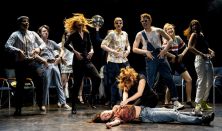
The Spinning Room
Zoltán Kodály
The Spinning Room
Folk scenes in Hungarian, with Hungarian and English surtitles

Zoltán Kodály
The Spinning Room
Folk scenes in Hungarian, with Hungarian and English surtitles
“A people can best be known through their folk songs,” claimed Zoltán Kodály, one of the crucial proponents of Hungarian music, whose main ambition as a composer, collector of folk songs and music teacher was to inculcate a love for Hungarian folk song and to cultivate a knowledgeable audience. The Spinning Room is the epitome of Kodály's efforts. When the Hungarian Royal Opera commissioned a full-length version of the work from the composer in 1931, it wasn't an opera that Kodály intended to write – instead his aim was to re-discover the Hungarian folk song and relay its simple dramatic power. Kodály was of Polish extraction on his mother's side. And now, breaking with convention, audiences will get the chance to see through the eyes of a Polish director, Michał Znaniecki, how a foreign artist perceives this quintessentially Hungarian work.
Director: Michał Znaniecki
Set designer: Luigi Scoglio
Assistant set designer: Alejandro Contreras Cortés
Costume designer: Magdalena Dabrowska
Lighting designer: Bogumił Palewicz
Animation designer: Bogumił Palewicz
Choreographer: Zsolt Juhász
Assistant choreographer: Adél Marosi
Dramaturg: Judit Kenesey
English translation by: Elisabeth M. Lockwood
Chorus director: Gábor Csiki

Bodó Viktor új előadása az önsegítő függő csoportok mintájára és igaz történetek alapján készül. A csoport olyan szélsőséges karakterek találkozóhelye,…
Az Elvált Nők Klubja - a kultfilmhez hasonlóan- egy fergeteges musical három nő történetéről, akik kénytelenek újra felépíteni saját életüket.
item(s) in basket
total:
Time limit has expired. Please, put item(s) in to basket again.